The world's rarest whale has been identified - two years after two of them washed up in New Zealand.
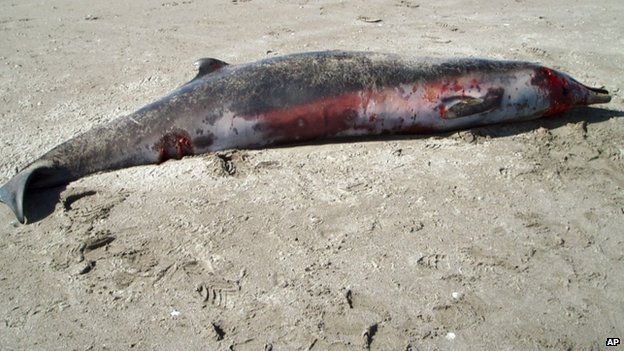
An adult female spade-toothed beaked whale and her calf were found beached in 2010, but they were mistaken for a more common type of whale and buried. When tests were done about six months later on samples taken from the mammals, they showed they were actually the rare spade-toothed beaked kind. The whales are so rare that nobody has ever seen one alive.
This year scientists returned to dig out the skeletons of the two whales, so they could study them. It wasn't an easy task and they found the mother's skull had been washed out to sea. Previously, only skull fragments have been discovered and that's only happened three times.
The spade-toothed beaked whale
The spade-toothed beaked whale gets its name because males have wide, blade-like, tusk teeth. Both males and females have beaks which make them look like dolphins. Not much is known about the whales, except that they live in the South Pacific Ocean and eat mainly squid.
Ethopian Wolf is genetically vulnerable and nearing extinction
Rarest dog: Ethiopian wolves are genetically vulnerable
Populations of the world's rarest dog, the Ethiopian wolf, are genetically fragmenting, scientists say.
Fewer than 500 of Africa's only wolf species are thought to survive. Now a 12-year study of Ethiopian wolves living in the Ethiopian highlands has found there is little gene flow between the small remaining populations. That places the wolves at greater risk of extinction from disease, or habitat degradation. In a study published in the journal , Dada Gottelli of the Zoological Society of London and colleagues in Oxford, UK and Berlin, Germany, quantified the genetic diversity, population structure and patterns of gene flow among 72 wild-living Ethiopian wolves.
Scientists say billions required to meet conservation targets
The most threatened species tend to be relatively cheap to save because of small range sizes.
Reducing the risk of extinction for threatened species and establishing protected areas for nature will cost the world over $76bn dollars annually. Researchers say it is needed to meet globally agreed conservation targets by 2020. The scientists say the daunting number is just a fifth of what the world spends on soft drinks annually. And it amounts to just 1% of the value of ecosystems being lost every year, they report in the journal Science.
“Nature just doesn't do recessions, we're talking about the irreversible loss of unique species and millions of years of evolutionary history” Donal McCarthy RSPB
Great Ape habitat in Africa has dramatically declined
Bonobos have less far to roam.
Great apes, such as gorillas, chimps and bonobos, are running out of places to live, say scientists. They have recorded a dramatic decline in the amount of habitat suitable for great apes, according to the first such survey across the African continent. Eastern gorillas, the largest living primate, have lost more than half their habitat since the early 1990s. Cross River gorillas, chimps and bonobos have also suffered significant losses, according to the study. Details are published in the journal Diversity and Distributions. "Several studies either on a site or country level indicated already that African ape populations are under enormous pressure and in decline," said Hjalmar Kuehl, of the Max Planck Institute for Evolutionary Anthropology in Leipzig, Germany, who helped organise the research.
Saving Ecuador's "Lungs of the World" Yasuni National Park.
Race to save Ecuador's 'lungs of the world'
The Napo River in Ecuador, an Amazon tributary, runs for 1,075km (668 miles).
The Yasuni National Park, known as "the lungs of the world" and one of the most bio-diverse places on earth, is under threat from oil drilling. The race is on to find the funds required to develop new sustainable energy programmes that would leave the oil - and the forest - untouched. In the early light of dawn, the Napo River, running swiftly from its headwaters in the high Andes, swirled powerfully past the bow of our motorised canoe. Suddenly, a dense cloud of green parrots swooped down from the canopy of the jungle and in a cackling din started scooping tiny beakfuls from the exposed muddy bank. The heavy mineral rich clay, the birds seem to know, is an antidote to the toxins present in the seeds of the forest which are a major part of their daily diets.
This inhospitable-looking landscape is home to some critically endangered species. The Niger government, this month, formally decreed this whole area - the Termit Massif and Tin Toumma desert - to be a national nature and cultural reserve. At almost 100,000 square kilometres it is the largest single protected area in Africa. One of Earth's most inhospitable deserts is an important stop-over for migrating wildlife, scientists say. Researchers working in the Termit Massif and Tin Toumma desert in Niger say the whole area should be protected, because it is a biodiversity "hotspot". The rocky massif is home to the Critically Endangered dama gazelle.
The elusive Saharan cheetah, captured here by a camera trap, also lives there. Scientists working for the Sahara Conservation Fund (SCF) are working to have the area declared a National Reserve. The rainy season transforms the arid landscape into a temporary wetland, which many migrating animals depend on.
Project to protect rare Burmese monkey gets new funding
Burmese snub-nosed monkey photographed by a camera trap in May 2011
A conservation project to help
protect the rare Burmese snub-nosed monkey is one of 33 to get a share of UK Government funding. The species was photographed for the first time last year. The project, led by Fauna and Flora International (FFI), will try to establish how many of the monkeys are left and how best to protect them. The money comes from a long-term scheme called the Darwin Initiative. The Burmese snub-nosed monkey was described scientifically for the first time in 2010 from a dead specimen collected by a local hunter. In May 2011 researchers working in northern Burma captured the first pictures of the species in its natural habitat. A team from FFI, Biodiversity and Nature Conservation Association (Banca), and People Resources and Conservation Foundation (PRCF) took the images using camera traps.



 Favorite
